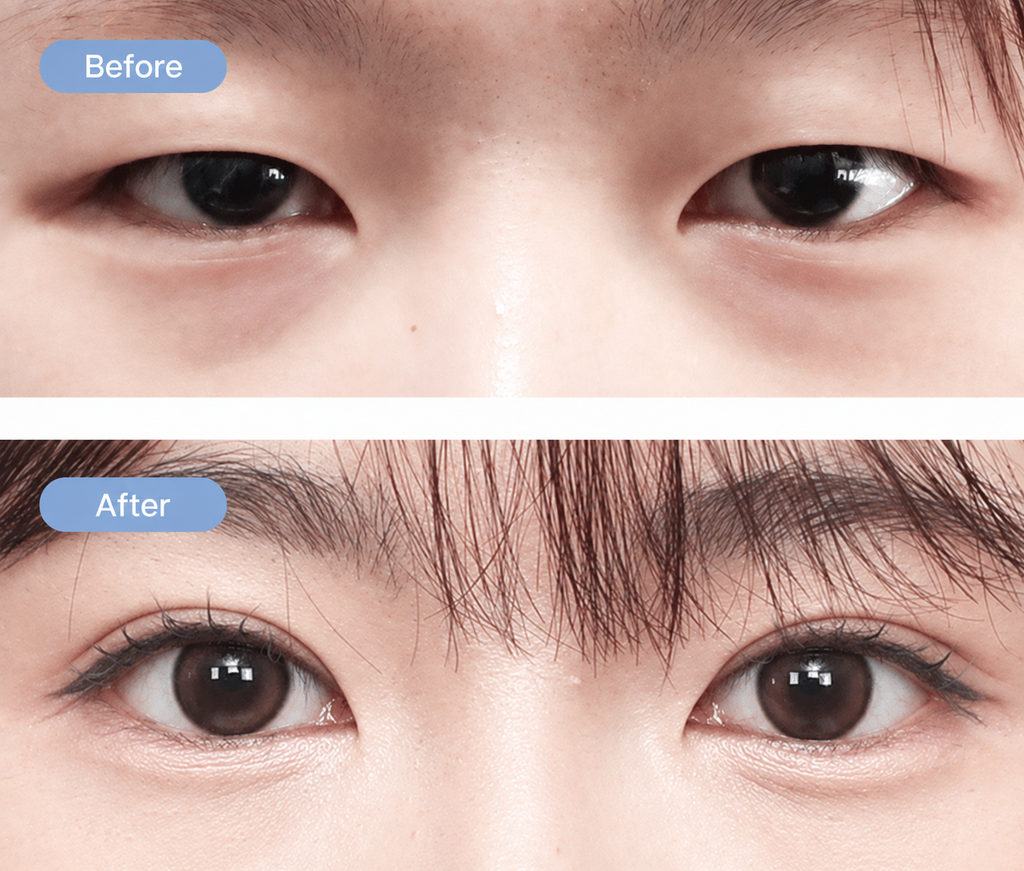
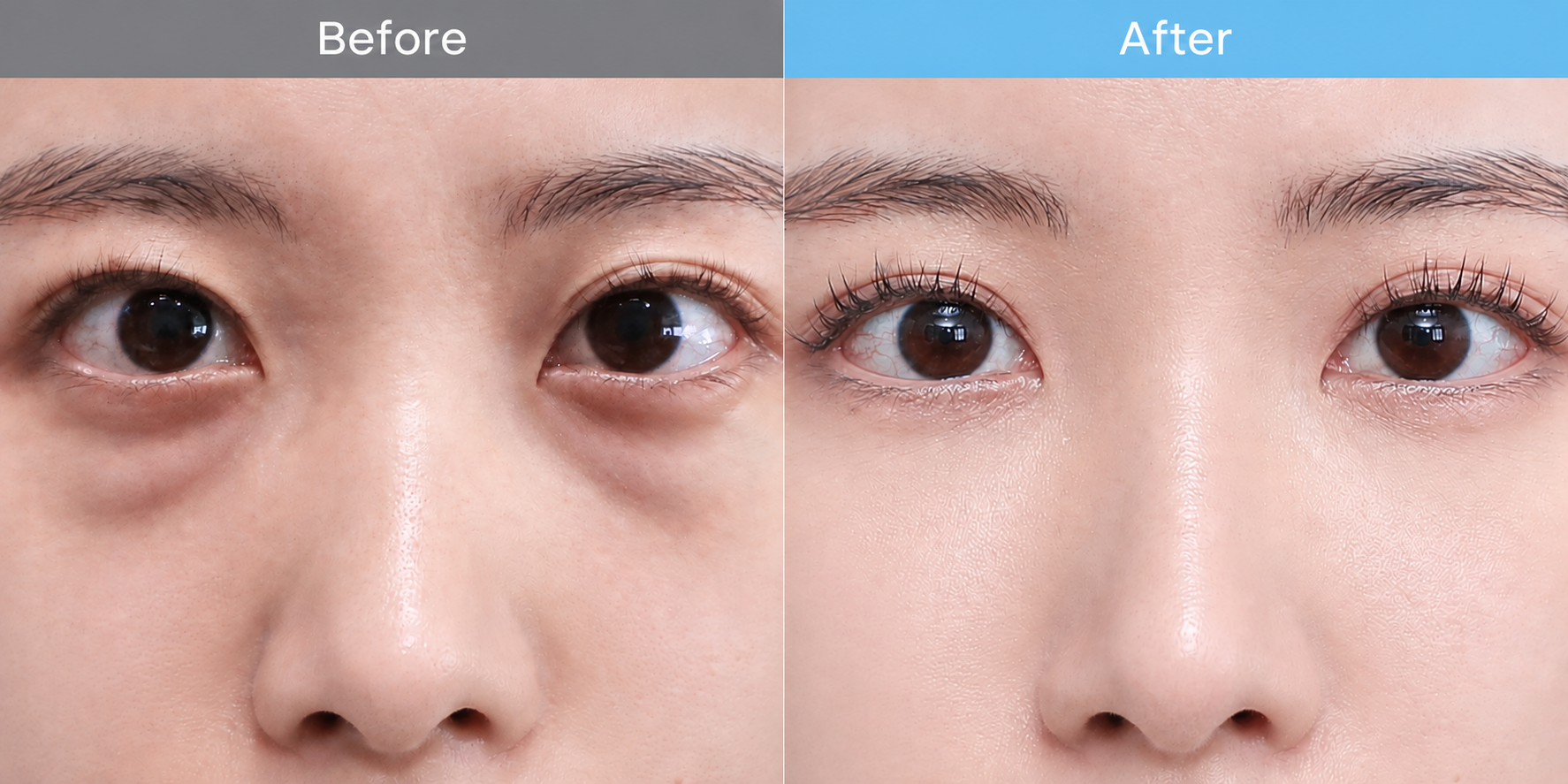
Do your under-eyes look puffy even when you’re well rested?
Or do shadows beneath your eyes make you look tired in photos, even after using concealer or skincare?
For some people, the problem isn’t simply skin tone. Bulging under-eye fat combined with a hollow tear trough can create shadows that make the under-eye area look darker and more tired.
This is one reason under eye fat repositioning in Korea has become increasingly popular among patients looking for a smoother, less tired appearance around the eyes.
At Haneul Plastic Surgery in Busan, under-eye surgery is planned according to the individual cause of the concern — including protruding fat, tear-trough hollowness, loose skin, and overall lower-eyelid anatomy.
But fat repositioning isn’t a treatment for every type of dark circle.
Here’s what to understand before surgery — including who may benefit, what before-and-after results can look like, and what to expect during recovery.
- Why Do My Under-Eyes Look Puffy or Dark?
- What Is Under Eye Fat Repositioning?
- Who May Consider Under Eye Fat Repositioning?
- Under Eye Fat Repositioning Before & After
- Will Under Eye Fat Repositioning Fix Dark Circles?
- Fat Repositioning vs Fat Removal: What’s the Difference?
- Do I Need Fat Grafting Too?
- What Is Recovery Like?
- Under Eye Fat Repositioning vs Lower Blepharoplasty
- Why Consider Haneul Plastic Surgery in Busan?
- FAQ: Under Eye Fat Repositioning in Korea
Why Do My Under-Eyes Look Puffy or Dark?
What we commonly call “dark circles” can actually have several different causes.
Your under-eye area may look tired because of:
- Bulging under-eye fat
- A hollow tear trough
- Shadows created by uneven contours
- Thin under-eye skin
- Visible blood vessels
- Pigmentation
- Loose or sagging skin
- A combination of several factors
This distinction matters.
If protruding fat sits directly above a hollow area, light can create a noticeable shadow between the two. This can make the under-eye area appear darker even when pigmentation itself isn’t the main problem.
In this situation, improving the contour between the under-eye bag and the hollow area may help create a smoother appearance.
However, if the darkness is primarily caused by pigmentation or visible blood vessels, fat repositioning alone may not fully correct it.
That is why the cause of the “dark circle” should be evaluated before choosing surgery.

What Is Under Eye Fat Repositioning?
Under-eye fat repositioning is designed to address uneven contours beneath the eyes.
Instead of simply removing protruding under-eye fat, the surgeon repositions the existing fat toward hollow areas, such as the tear trough, when appropriate.
A simple way to understand the goal is:
- Before
- Bulging fat → Hollow area → Shadow
- After repositioning
- Smoother transition between the lower eyelid and cheek
The goal is not to remove as much fat as possible.
Removing too much volume can potentially leave the under-eye area looking hollow or sunken. The surgical plan therefore needs to consider both the bulging area and the hollow area beneath it.
Want to learn more about the procedure itself? Read our complete guide to Lower Eyelid Fat Repositioning in Busan, including the procedure, candidates, recovery, and treatment information.
→ [ Lower Eyelid Fat Repositioning in Busan Treatment ]
Who May Consider Under Eye Fat Repositioning?
This procedure may be considered if you notice:
- Puffy or bulging fat beneath the eyes
- Under-eye bags that remain even when you’re rested
- A noticeable groove or tear trough below the eye bag
- Shadows that make the under-eye area appear darker
- A tired appearance caused by uneven under-eye contours
Age alone doesn’t determine whether someone is a candidate.
Some younger patients have genetically prominent under-eye fat, while others develop more noticeable changes as the tissues around the eyes change with age.
The more important question is:
What is actually causing your under-eye concern?
Under Eye Fat Repositioning Before & After
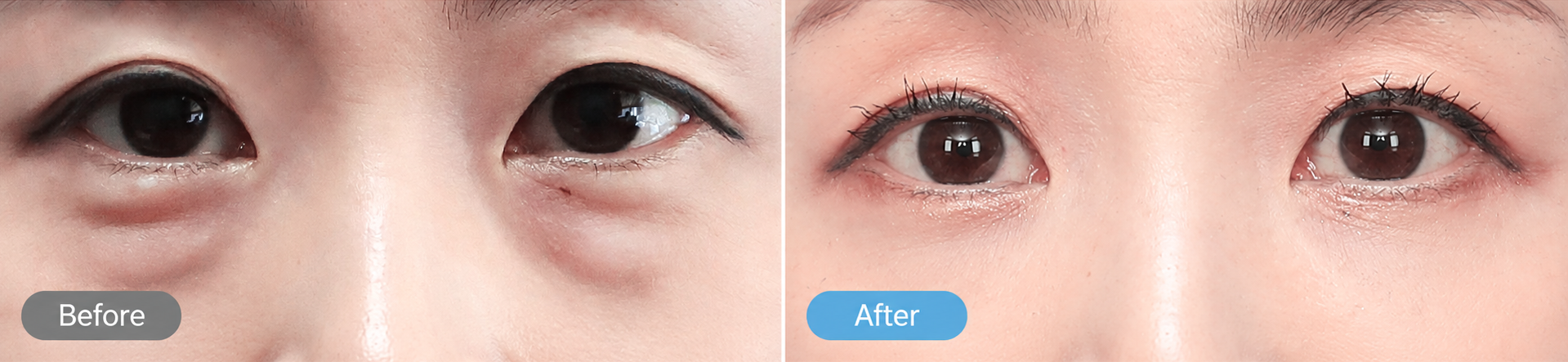
Before-and-after photos are particularly useful for this procedure because the goal is often about improving contour rather than creating a dramatic transformation.
When comparing photos, look at:
- The bulge beneath the eyes
- Tear-trough hollowness
- The transition between the lower eyelid and cheek
- Shadows underneath the eyes
- Left-right symmetry
- Whether the result still looks natural
Also check when the after photo was taken.
Early postoperative photos may still show swelling, so they should not be interpreted in the same way as results photographed after the tissues have had more time to settle.
For your Haneul cases, I recommend displaying the postoperative timing directly with the image, for example:
This makes the B&A much more useful to international patients evaluating the result.
Will Under Eye Fat Repositioning Fix Dark Circles?
This is one of the most important questions to ask before surgery.
Sometimes — but not all dark circles have the same cause.
If the dark appearance is largely caused by shadows from:
under-eye bulging + tear-trough hollowness
smoothing that contour may make the area appear less dark and tired.
But fat repositioning is not a universal dark-circle treatment.
If your dark circles are mainly related to:
- Pigmentation
- Thin skin
- Visible blood vessels
- Other skin-related factors
another treatment or combination of treatments may be more appropriate.
The important point is:
Treat the cause, not simply the word “dark circles.”
Fat Repositioning vs Fat Removal: What’s the Difference?
Traditional fat removal focuses primarily on reducing protruding fat.
Fat repositioning takes a different approach.
Instead of simply removing volume, existing under-eye fat can be redistributed to help smooth the transition into hollow areas.
| Fat Removal | Fat Repositioning | |
|---|---|---|
| Main Goal | Reduce protruding fat | Reduce bulging while smoothing hollow areas |
| Existing Fat | Removed | Repositioned when appropriate |
| Tear Trough | May require separate consideration | Can be addressed as part of contour planning |
| Main Focus | Volume reduction | Smoother under-eye contour |
The appropriate technique depends on your anatomy.
The objective shouldn’t simply be to make the under-eye area as flat as possible. It should be to create a natural transition between the lower eyelid and cheek.
Do I Need Fat Grafting Too?
Not necessarily.
Some patients may be suitable for fat repositioning alone, while additional fat grafting may be considered when there is more significant volume loss or hollowness.
Whether additional fat grafting makes sense depends on factors such as:
- Degree of hollowness
- Amount of existing under-eye fat
- Midface volume
- Previous procedures
- Overall facial anatomy
More procedures do not automatically mean a better result.
If additional fat grafting is recommended, ask what specific problem it is intended to correct.
What Is Recovery Like?
Swelling and bruising can occur after under-eye fat repositioning.
During early recovery, the two sides may also appear temporarily different because swelling does not always resolve at exactly the same rate.
This can be worrying when you’re checking your eyes every day, but early appearance is not the final result.
The under-eye contour can continue to change as swelling gradually subsides and the tissues settle.
Your surgeon should explain:
- Expected swelling and bruising
- Postoperative care
- Activity restrictions
- Follow-up schedule
- When results can reasonably be evaluated
If you’re visiting Korea for surgery, share your departure date before confirming the procedure so your postoperative schedule can be planned around your trip.
Under Eye Fat Repositioning vs Lower Blepharoplasty
These procedures can address different problems around the lower eyelid.
Fat repositioning may be considered when fat protrusion and tear-trough contour are the major concerns.
However, some patients also have significant:
- Loose lower-eyelid skin
- Fine wrinkles
- Skin laxity
- Other age-related structural changes
In these cases, simply repositioning fat may not address everything.
A lower blepharoplasty or another surgical approach may be discussed when excess skin and other lower-eyelid changes also need to be addressed.
This is why choosing surgery based only on a procedure name you’ve seen online isn’t ideal.
The operation should be selected after evaluating your actual lower-eyelid anatomy.
Why Consider Haneul Plastic Surgery in Busan?
The under-eye area is small, but its anatomy is complex.
At Haneul Plastic Surgery in Busan, the surgical plan begins by identifying what is actually creating the tired or uneven appearance beneath the eyes.
Individual Under-Eye Assessment
The surgeon can evaluate whether the primary concern is fat protrusion, hollowness, loose skin, or a combination of factors.
Treatment Based on Anatomy
Not every patient with dark circles requires fat repositioning, and not every patient with under-eye bags needs the same operation.
The surgical approach is selected according to the individual eye area rather than applying the same procedure to every patient.
Before & After Consultation
Existing Haneul before-and-after cases can help international patients understand possible changes and communicate the type of result they prefer.
International Patient Support
International patients can receive assistance with pre-visit consultation, medical interpretation, appointment coordination, and postoperative communication.
If you’re traveling specifically for surgery, your Korea schedule can also be considered when arranging consultation, surgery, and follow-up.
FAQ: Under Eye Fat Repositioning in Korea
Does under eye fat repositioning really help dark circles?
It can help when the dark appearance is largely caused by shadows from protruding fat and tear-trough hollowness.
However, dark circles caused primarily by pigmentation, thin skin, or visible blood vessels may not be fully corrected by fat repositioning.
Will under eye fat repositioning make my eyes look hollow?
The goal is to avoid an excessively hollow appearance by redistributing fat rather than simply removing as much as possible.
However, results depend on the patient’s anatomy and surgical plan, which is why careful evaluation of both protrusion and existing hollowness is important.
How long does swelling last after under eye fat repositioning?
Recovery varies between patients.
Swelling and bruising are expected during early healing, and the two sides may not improve at exactly the same rate.
The under-eye contour can continue changing after the most obvious swelling has subsided, so the early postoperative appearance should not be considered the final result.
When will I see my final result?
You may notice changes as initial swelling improves, but the tissues can continue settling for weeks to months.
This is why before-and-after photos should always be interpreted together with the postoperative timing of the photo.
Do I need fat grafting with under eye fat repositioning?
Not everyone does.
Fat grafting may be considered when additional volume is needed beyond what can be achieved with repositioning alone.
The decision depends on the degree of hollowness, available fat, facial anatomy, and desired result.
Is under eye fat repositioning only for older patients?
No.
Younger patients can also have genetically prominent under-eye bags or tear-trough hollowness.
Suitability depends more on anatomy and the cause of the under-eye concern than age alone.
Can under eye bags come back after surgery?
The procedure can create a long-lasting structural change, but it does not stop the natural aging process.
The tissues around the eyes can continue changing over time, so cosmetic surgery should not be viewed as permanently stopping age-related changes.
Should I get under eye fat repositioning or lower blepharoplasty?
That depends on what is causing the problem.
If fat protrusion and hollowness are the primary concerns, fat repositioning may be considered.
If significant loose skin, wrinkles, or other lower-eyelid changes are also present, a different or broader surgical approach may be discussed.
A consultation is needed to determine which approach is appropriate.
Considering Under Eye Fat Repositioning at Haneul Plastic Surgery?
If you’re considering under eye fat repositioning in Busan, start by identifying what actually bothers you when you look in the mirror.
Is it the bulging?
The hollow underneath it?
The dark shadow?
Loose skin?
Or a combination of several concerns?
You can share photos of your under-eye area and your Korea travel dates with Haneul Plastic Surgery before visiting Busan.
The surgeon can then assess whether fat repositioning — or another approach — makes sense for your individual anatomy.
The goal isn’t simply to remove under-eye fat. It’s to create a smoother, more natural transition beneath the eyes.