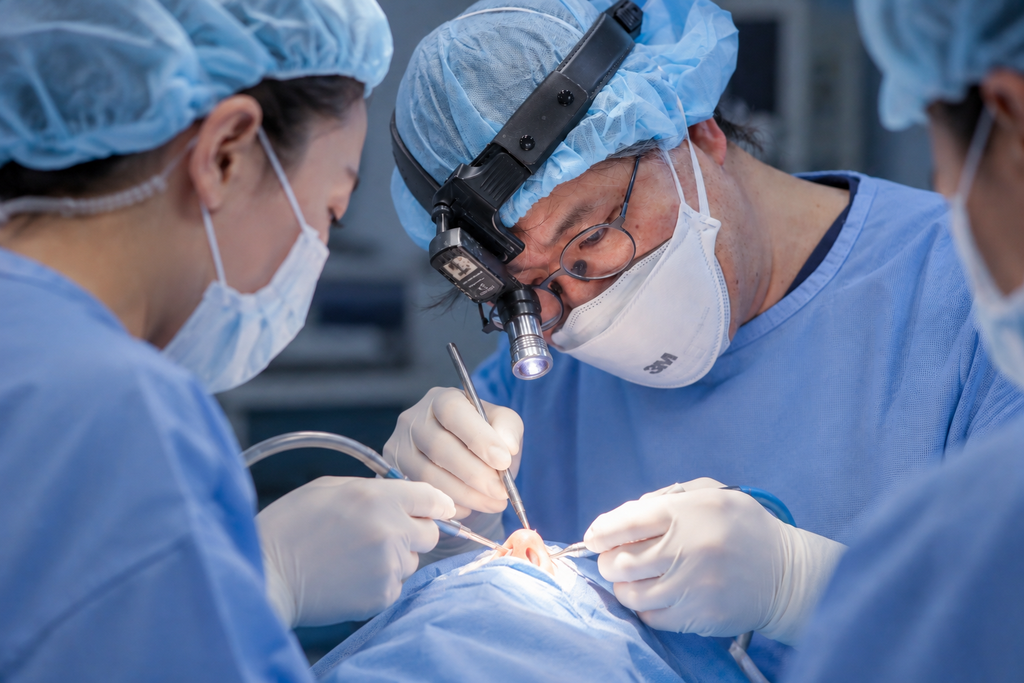
If you’re researching double eyelid surgery in Busan, one of the first decisions you’ll come across is:
Incisional or non-incisional?
Both methods are commonly used for double eyelid surgery in Korea, but they are not simply two ways of achieving exactly the same result.
Your eyelid thickness, amount of fat and excess skin, existing crease, eye-opening strength, asymmetry, and the type of crease you want can all affect which method may be more appropriate.
At Haneul Plastic Surgery in Busan, double eyelid surgery begins with an individual consultation and eyelid design rather than choosing a surgical method based on trends alone.
This guide explains the differences between incisional and non-incisional double eyelid surgery, what recovery can look like, possible additional procedures, and what international patients should consider before having surgery in Korea.
- What Is Double Eyelid Surgery?
- Incisional vs Non-Incisional Double Eyelid Surgery
- Who May Be Suitable for Non-Incisional Double Eyelid Surgery?
- Who May Be Suitable for Incisional Double Eyelid Surgery?
- Double Eyelid Surgery Before & After
- Do I Need Ptosis Correction or Canthoplasty Too?
- How Much Is Double Eyelid Surgery in Busan?
- What Is Recovery Like After Double Eyelid Surgery?
- How to Choose a Double Eyelid Surgeon in Korea
- Why Consider Haneul Plastic Surgery in Busan?
- FAQ: Double Eyelid Surgery in Busan
What Is Double Eyelid Surgery?
Double eyelid surgery creates or defines a crease in the upper eyelid.
While it may sound like a relatively simple procedure, the goal isn’t just to “make a fold.”
The height and shape of the crease can affect how natural, open, or defined the eyes appear in relation to the rest of the face.
Factors considered during consultation may include:
- Eyelid skin thickness
- Upper-eyelid fat
- Existing eyelid crease
- Excess or loose skin
- Eye asymmetry
- Eye-opening strength
- Distance between the eyes and eyebrows
- Desired crease height and shape
For this reason, two patients requesting the same double eyelid line may require different surgical approaches.

Incisional vs Non-Incisional Double Eyelid Surgery
One of the most common questions among international patients researching double eyelid surgery in Korea is whether they should choose the incisional or non-incisional method.
Here is a simplified comparison.
| Non-Incisional | Incisional | |
|---|---|---|
| How it works | Creates the eyelid crease through small fixation points without a full-length incision | Creates the crease through an incision along the planned eyelid fold |
| Often considered for | Patients with relatively thin eyelids and limited excess skin | Patients with thicker eyelids, excess skin or tissue, or when more structural adjustment is needed |
| Tissue removal | Limited | Skin, fat, or other tissue may be adjusted when appropriate |
| Swelling | Generally less in early recovery | Generally more noticeable in early recovery |
| Scar | No full-length incision line | Incision follows the designed eyelid crease |
| Crease stability | May loosen or weaken over time in some patients | Generally provides stronger structural fixation |
| Main advantage | Smaller incisions and generally quicker early recovery | Allows more extensive adjustment of eyelid tissue |
| Main limitation | Not appropriate for every eyelid anatomy | Usually requires a longer recovery period |
Neither technique is automatically better.
The important question is which method fits your eyelid anatomy and desired result.
Who May Be Suitable for Non-Incisional Double Eyelid Surgery?
Non-incisional double eyelid surgery is sometimes called the buried suture method or, depending on the technique used by the clinic, natural adhesion double eyelid surgery.
Rather than making a full incision along the eyelid, the crease is created through smaller access points and internal fixation.
It may be considered when:
- The upper-eyelid skin is relatively thin
- There is limited excess skin
- There is not a large amount of eyelid fat or heavy tissue
- A less invasive approach is appropriate
- The patient prefers a shorter early recovery period
One concern frequently raised by international patients is whether a non-incisional crease will eventually loosen.
This can happen in some patients, which is why anatomy matters. Choosing a non-incisional technique simply because it appears easier or has less downtime may not be appropriate if the eyelid structure requires stronger or more extensive correction.
Who May Be Suitable for Incisional Double Eyelid Surgery?
With the incisional method, an incision is made along the planned eyelid crease.
This gives the surgeon greater access to the eyelid structures and allows tissue to be adjusted when necessary.
It may be considered when:
- The eyelids are thicker
- There is excess or loose upper-eyelid skin
- There is more eyelid fat or tissue to address
- Stronger crease fixation is needed
- Previous double eyelid surgery requires revision
- The eyelid anatomy is not well suited to a non-incisional approach
Because an incision is involved, swelling and the visible healing process generally take longer than with non-incisional surgery.
However, incisional does not automatically mean an unnatural or dramatic-looking crease.
The final appearance also depends on factors such as crease height, design, anatomy, tissue handling, and surgical planning.
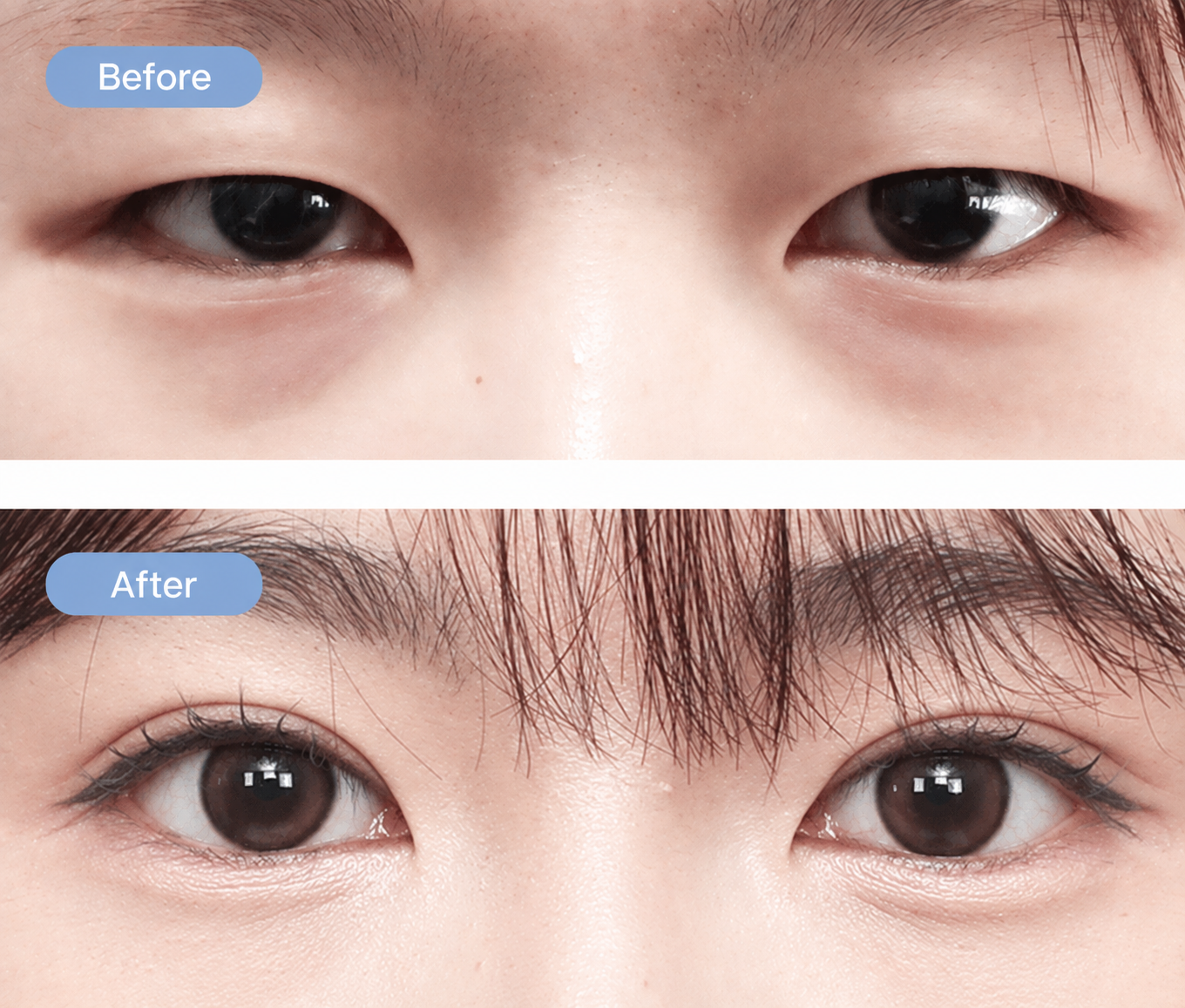
Double Eyelid Surgery Before & After
Before-and-after photos can be especially useful when researching double eyelid surgery in Busan.
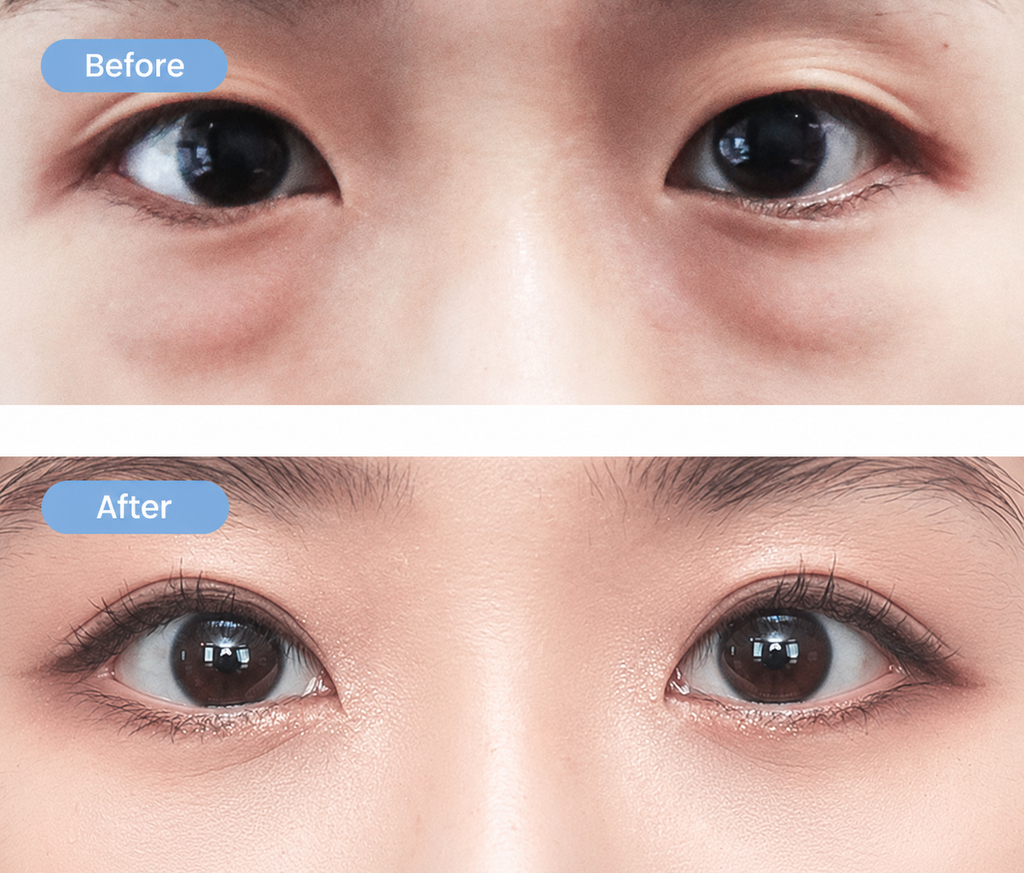
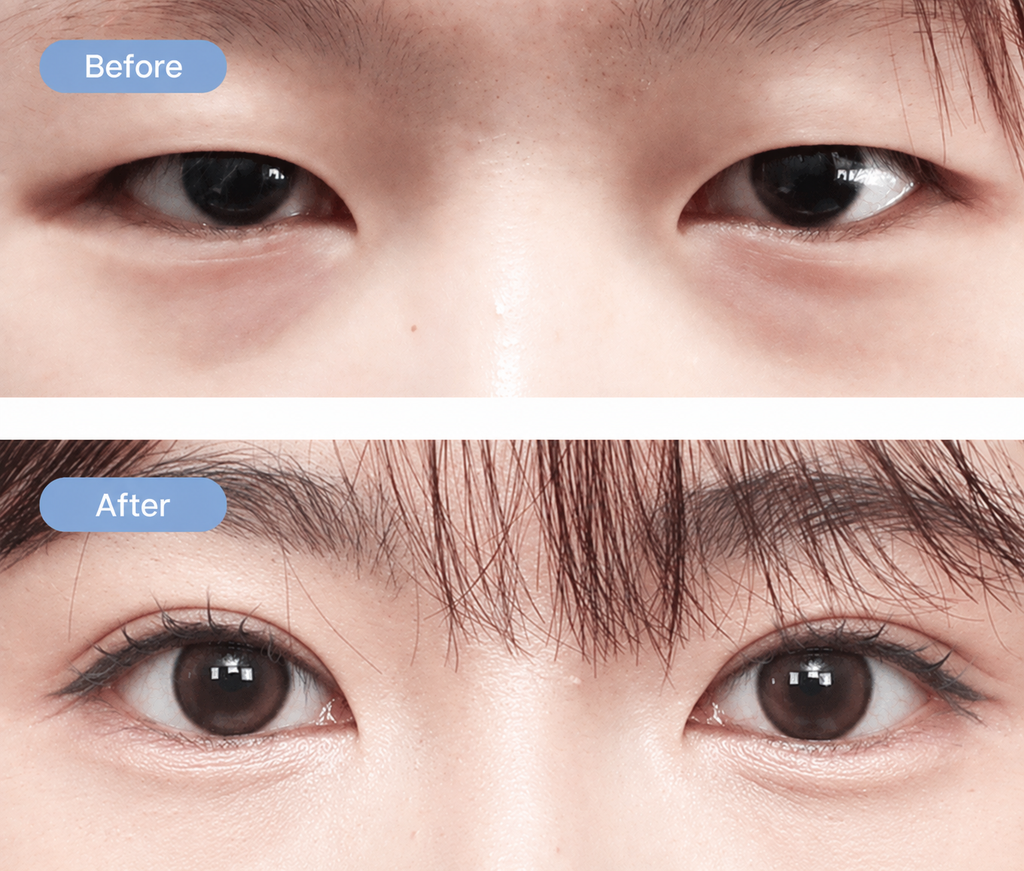
When looking at before-and-after photos, don’t focus only on whether the eyes look “bigger.”
Look at:
- Crease height
- Crease shape
- Left-right symmetry
- How the crease fits the patient’s original eye shape
- Whether the result looks natural with the rest of the face
- Incisional vs non-incisional technique
- How long after surgery the “after” photo was taken
Ideally, compare cases with eyelid anatomy similar to your own rather than choosing a crease simply because you like it on another person.
Reference photos can still be useful during consultation, but they should communicate the style you prefer, not guarantee an identical result.
Do I Need Ptosis Correction or Canthoplasty Too?
Double eyelid surgery can be performed alone.
However, depending on the eye structure and the patient’s goals, additional procedures may sometimes be discussed.
Ptosis Correction
If the strength used to open the eyes is weak or the upper eyelid covers more of the eye than desired, ptosis correction (eye-opening correction) may be considered.
Haneul offers both incisional and non-incisional approaches to eye-opening correction depending on the patient’s condition.
This is different from simply creating a higher double eyelid crease.
Epicanthoplasty & Canthoplasty
Some patients may also discuss procedures that modify the inner or outer corners of the eyes.
These can include:
- Medial epicanthoplasty
- Lateral canthoplasty
- Other eye-corner procedures depending on anatomy
They are not automatically required simply because you’re having double eyelid surgery.
Whether an additional procedure makes sense should depend on your eye shape, proportions, and desired change rather than being treated as a standard package.
How Much Is Double Eyelid Surgery in Busan?
At Haneul Plastic Surgery, double eyelid surgery is generally in the ₩1 million range, although the final cost depends on the surgical method and individual treatment plan.
The price may increase when additional procedures are required or requested, such as:
- Ptosis correction
- Epicanthoplasty
- Lateral canthoplasty
- Other eye-shape correction procedures
For example, someone requiring only double eyelid surgery may have a different surgical plan and total cost from someone having double eyelid surgery combined with ptosis correction and canthoplasty.
For international patients, it is therefore more useful to ask for the total estimated surgical plan rather than comparing only the advertised starting price.
The final surgical method and price should be confirmed after consultation.
What Is Recovery Like After Double Eyelid Surgery?
Recovery varies according to the surgical method and the individual.
In general, swelling and bruising are expected during the early recovery period.
Non-incisional surgery usually has a shorter early recovery period, while incisional surgery tends to involve more swelling and a longer period before the eyelid crease begins to look settled.
However, returning to daily activities and looking completely natural are not the same thing.
Even after major swelling improves, the crease can continue to change and soften as healing progresses.
If you’re traveling to Korea specifically for surgery, plan enough time for:
- Surgery
- Early postoperative checks
- Any required stitch removal
- Monitoring of initial healing
- Follow-up before flying home
Tell the clinic your arrival and departure dates before confirming surgery so your schedule can be planned appropriately.
How to Choose a Double Eyelid Surgeon in Korea
If you’re comparing clinics for double eyelid surgery in Korea, don’t make the decision based only on the lowest price or the largest number of before-and-after photos.
- Does the surgeon evaluate your individual eyelid anatomy?
- A consultation should look beyond the presence or absence of a double eyelid crease.
- Does the surgeon explain why incisional or non-incisional surgery is being recommended?
- The recommendation should make sense for your eyelid structure rather than simply follow your initial preference.
- Can you see relevant before-and-after cases?
- Cases with similar anatomy and aesthetic goals can be more useful than unrelated dramatic transformations.
- Are additional procedures clearly explained?
- If ptosis correction or canthoplasty is suggested, ask what concern it is intended to address.
- Is follow-up available for international patients?
- This becomes especially important once you return home.
Why Consider Haneul Plastic Surgery in Busan?
Haneul Plastic Surgery has provided plastic surgery care in Busan for more than 26 years.
For double eyelid surgery, Haneul offers both natural adhesion/non-incisional and incisional approaches, with the method selected according to individual eye condition and surgical goals.
Individual Eyelid Design
The crease is planned according to the patient’s eye anatomy, facial balance, and desired appearance rather than applying the same eyelid design to every patient.
Incisional & Non-Incisional Options
Both approaches are available, allowing the surgical plan to be selected according to eyelid thickness, tissue, excess skin, existing crease, and other anatomical factors.
Additional Eye Procedures When Appropriate
Ptosis correction and eye-corner procedures can also be discussed when additional structural or aesthetic concerns are present.
Support for International Patients
International patients can arrange pre-visit consultation and medical interpretation to discuss their goals and travel schedule before surgery.
Follow-up communication can also continue after returning home.
FAQ : Double Eyelid Surgery in Busan
Is incisional or non-incisional double eyelid surgery better?
Neither method is universally better.
Non-incisional surgery may be suitable for certain patients with thinner eyelids and limited excess tissue, while an incisional approach allows more extensive tissue adjustment and stronger structural fixation.
Your eyelid anatomy should determine the method rather than choosing based only on recovery time.
How long does non-incisional double eyelid surgery last?
There is no universal number of years that applies to everyone.
A non-incisional crease can remain for a long time, but it may loosen or become less defined in some patients. Eyelid anatomy, tissue characteristics, technique, and individual changes over time can all influence longevity.
This is one of the most frequently discussed concerns among people researching non-incisional surgery in Korea.
Does incisional double eyelid surgery always look more dramatic?
No.
An incisional technique describes how the surgery is performed, not how high or dramatic the final crease must be.
Crease height, shape, eyelid anatomy, and surgical design all influence the final appearance.
How long does double eyelid surgery take to look natural?
This varies considerably between patients and surgical methods.
Early swelling improves first, while the crease can continue to soften and settle over the following weeks and months. Incisional surgery generally requires more healing time than a non-incisional procedure.
If you have an important event, don’t schedule surgery based only on the minimum downtime.
How long should I stay in Korea after double eyelid surgery?
Your required stay depends on the surgical method, postoperative schedule, and whether stitches need to be removed.
International patients should provide their departure date before surgery so that postoperative checks and any required stitch removal can be incorporated into the plan.
Do I need ptosis correction with double eyelid surgery?
Not everyone does.
Ptosis correction addresses eye-opening function or strength rather than simply creating the eyelid crease. It may be discussed if the surgeon identifies an eye-opening concern during consultation.
Questions about whether ptosis correction is genuinely necessary are also common among international patients researching double eyelid surgery in Korea.
Do I need epicanthoplasty or lateral canthoplasty too?
Not necessarily.
Double eyelid surgery can be performed by itself. Eye-corner procedures should only be considered when they address a specific anatomical concern or aesthetic goal.
If additional surgery is recommended, ask the surgeon to explain exactly what it is intended to change.
How much does double eyelid surgery cost in Busan?
At Haneul Plastic Surgery, double eyelid surgery is generally in the ₩1 million range.
The total price can increase if your surgical plan includes additional procedures such as ptosis correction, epicanthoplasty, lateral canthoplasty, or other eye surgery.
Final pricing is determined after consultation.
Can I choose my double eyelid shape using a reference photo?
You can bring reference photos to communicate the type of crease you like.
However, the same crease will not look identical on every person because eyelid anatomy, skin thickness, eye shape, brow position, and facial proportions differ.
Reference photos are best used as a communication tool rather than an exact surgical template.
Considering Double Eyelid Surgery at Haneul Plastic Surgery in Busan?
If you’re researching double eyelid surgery in Busan, you don’t need to decide between incisional and non-incisional surgery before your consultation.
Start with the result you want.
You can share photos of your eyes, reference images, previous eye procedures, preferred crease style, and your travel dates before visiting Korea.
At Haneul Plastic Surgery in Busan, the final surgical method can then be discussed after evaluating your individual eyelid anatomy and goals.