If you’re considering Asian Blepharoplasty in Busan, one of the first questions you may have is:
What kind of double eyelid crease would actually suit my eyes?
In Korea, double eyelid surgery is not simply about creating a fold. The height, starting point, and shape of the crease can change how natural, defined, or open the eyes appear.
You may already have reference photos saved on your phone—or know that you prefer an in-line, in-out, semi-out, or out-line crease.
But the line you like and the line that works naturally with your eyes are not always the same.
At Haneul Plastic Surgery in Busan, double eyelid surgery is planned by considering your existing eye shape, eyelid thickness, skin laxity, tissue distribution, inner eye structure, and the overall appearance you want to achieve.
For international patients traveling to Korea for eyelid surgery, understanding these differences before your consultation can make it much easier to communicate the result you want.
- What Is Asian Blepharoplasty?
- 4 Double Eyelid Shapes: Which One Is Right for You?
- Don’t Choose Your Double Eyelid Shape From a Photo Alone
- Natural Adhesion vs Incisional Double Eyelid Surgery
- Asian Blepharoplasty Before & After
- Traveling to Busan for Asian Blepharoplasty
- FAQ: Asian Blepharoplasty in Busan
- Find the Double Eyelid Line That Fits Your Eyes
What Is Asian Blepharoplasty?
Asian blepharoplasty, commonly known as double eyelid surgery, creates or defines a crease in the upper eyelid.
Asian eyelids naturally vary considerably. Differences in the epicanthal fold, fat distribution, skin thickness, and internal eyelid anatomy can all affect whether a crease is visible and how it appears.
This is why Asian blepharoplasty should not be thought of as creating one standard “Korean” eye shape.
The goal is to design a crease that works with your existing anatomy and desired appearance.
At Haneul Plastic Surgery, four main double eyelid shapes may be considered:
- In-Line
- In-Out Line
- Semi-Out Line
- Out-Line
So, what is the difference?

4 Double Eyelid Shapes: Which One Is Right for You?
The biggest visual difference between double eyelid designs is where the crease begins near the inner corner and how visible it remains across the eyelid.
Current Korean double-eyelid terminology commonly separates these designs into in-line, in-out, semi-out, and out-line variations.
| Double Eyelid Shape | Appearance | May Appeal to Patients Who Want |
|---|---|---|
| In-Line | Subtle crease that begins close to the inner corner | A soft, natural-looking change |
| In-Out Line | Natural inner start with more visible definition outward | A balance between natural and defined |
| Semi-Out Line | More visible from the inner area than an in-out line | A clearer, more noticeable crease without going fully out-line |
| Out-Line | Crease remains visibly separated toward the inner corner | A more prominent and defined double eyelid |
Let’s look at each design more closely.
1. In-Line: Soft and Natural
An in-line double eyelid begins close to the inner corner of the eye, with the inner portion of the crease appearing relatively subtle.
As the line continues outward, it becomes more visible.
Because the crease follows the natural structure of the inner eye closely, an in-line design can create a softer and less obvious change.
It may be worth discussing if your priority is:
- A subtle double eyelid
- A natural-looking crease
- Less emphasis on the inner portion of the eyelid
- A result that works closely with your existing eye shape
For patients who tell us, “I want double eyelids, but I don’t want them to look too obvious,” an in-line design may be one of the options considered.
2. In-Out Line: Natural but More Defined
The in-out line sits between a subtle in-line and a more visible out-line.
The crease begins near the inner corner and gradually becomes more noticeable across the middle and outer eyelid.
This can create more definition while maintaining a relatively natural transition at the inner eye.
An in-out line may appeal to someone who wants:
- More visible definition than an in-line
- A balanced crease
- A natural inner corner
- A double eyelid that becomes clearer toward the outer eye
For this reason, it can be an attractive middle-ground option.
3. Semi-Out Line: A More Noticeable Crease
The semi-out line creates slightly more separation and visibility near the inner portion of the eye than an in-out line.
It can provide a more defined appearance without creating the full effect of an out-line.
This design may appeal to patients who feel:
“In-out looks a little too subtle, but I don’t want a full out-line.”
The difference between in-out and semi-out can sometimes appear small in photographs, but the position where the crease begins near the inner corner can noticeably affect the overall impression of the eyes.
4. Out-Line: More Visible and Defined
With an out-line, the crease remains more visibly separated around the inner portion of the eyelid rather than disappearing into the inner fold.
This can make the double eyelid appear more prominent across the entire eye.
It may appeal to patients looking for:
- A more visible double eyelid
- Greater crease definition
- A more noticeable change
- A stronger eye contour
However, wanting an out-line does not necessarily mean that it will be the most suitable design for every eye.
The inner eye structure, epicanthal fold, eyelid thickness, existing crease, and overall proportions need to be considered before deciding how the crease should begin.
Don’t Choose Your Double Eyelid Shape From a Photo Alone
Many patients visiting Korea arrive with screenshots of celebrities, influencers, or before-and-after cases they like.
That’s actually useful.
Reference photos can help your surgeon understand whether you prefer a subtle, defined, narrow, or more visible crease.
However, they should be used as references rather than templates.
Two people asking for the same semi-out line may require different crease heights or surgical plans because their eyelid anatomy is different.
Factors that may influence the design include:
- Natural eye shape
- Existing crease
- Eyelid skin thickness
- Amount and distribution of eyelid tissue
- Skin laxity
- Epicanthal fold
- Eye-opening function
- Eyebrow-to-eye proportions
- Desired degree of definition
Asian eyelid anatomy itself also varies considerably between individuals, which is why personalized crease planning is an important part of Asian Blepharoplasty in Korea.
Natural Adhesion vs Incisional Double Eyelid Surgery
Once you’ve discussed what the crease should look like, there is another important question:
How should the crease be created?
At Haneul Plastic Surgery, the surgical method is selected according to the patient’s eyelid condition rather than the preferred line alone.
Natural Adhesion Double Eyelid Surgery
Natural adhesion double eyelid surgery uses fine sutures to help create an adhesion that forms and maintains the eyelid crease.
It may be considered depending on factors such as eyelid structure, skin condition, and the amount of correction required.
Incisional Double Eyelid Surgery
Incisional double eyelid surgery uses an incision along the planned crease.
This approach allows the surgeon to address issues such as loose or drooping eyelid skin when necessary and create a more clearly defined crease.
| Natural Adhesion | Incisional | |
|---|---|---|
| Approach | Fine sutures and adhesion | Incision along planned crease |
| Main advantage | Less extensive surgical approach | Allows more direct tissue adjustment |
| May be considered when | Eyelid condition is suitable for adhesion technique | Loose skin or greater tissue correction is required |
| Crease design | In-line, in-out, semi-out or other appropriate design depending on anatomy | Individually designed depending on anatomy |
Importantly, the line and surgical method are two separate decisions.
Choosing a semi-out line, for example, does not automatically determine whether you need natural adhesion or an incisional technique.
Your eyelid anatomy determines which method can create and maintain the planned crease appropriately.
Asian Blepharoplasty Before & After
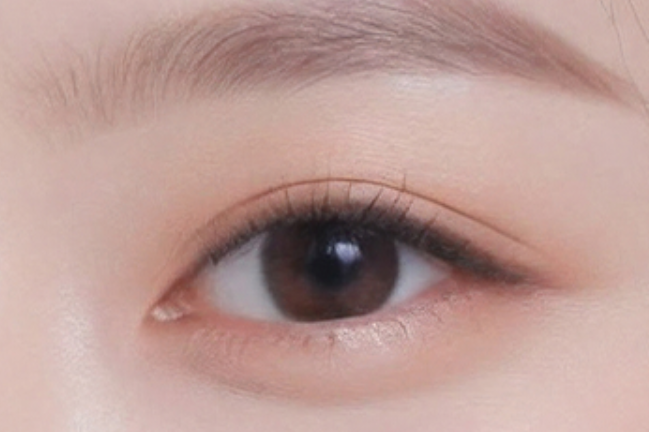
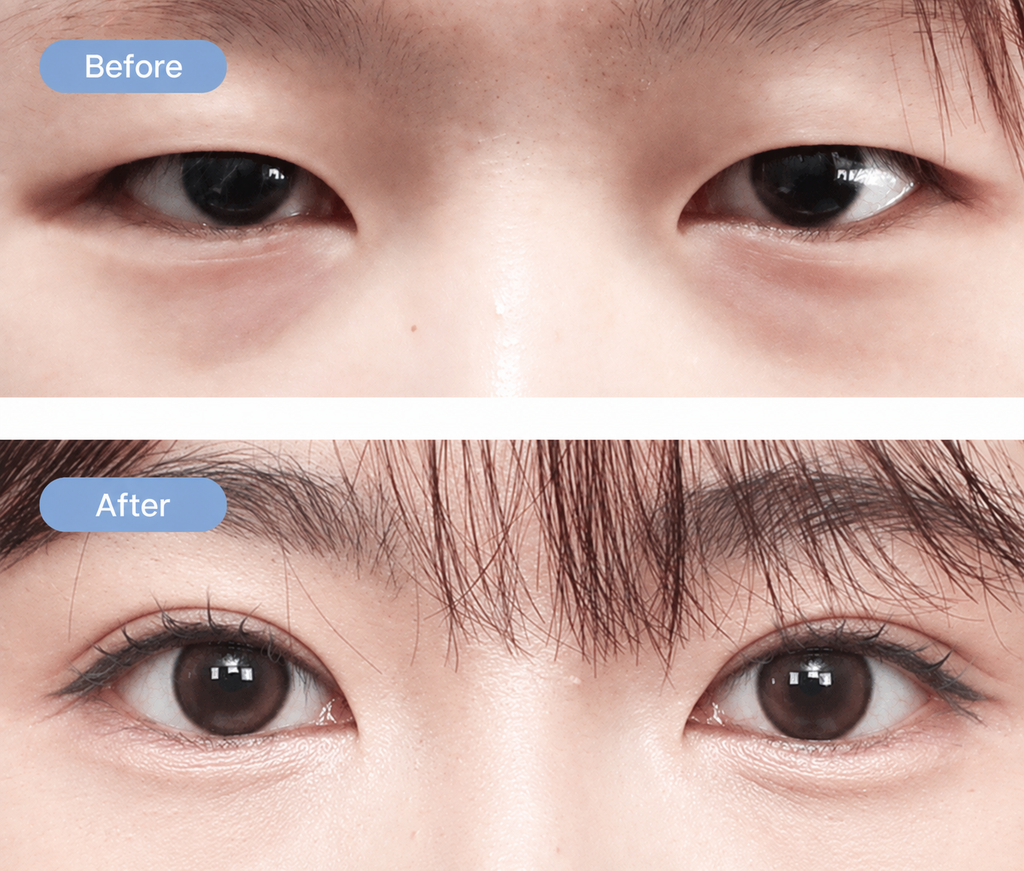
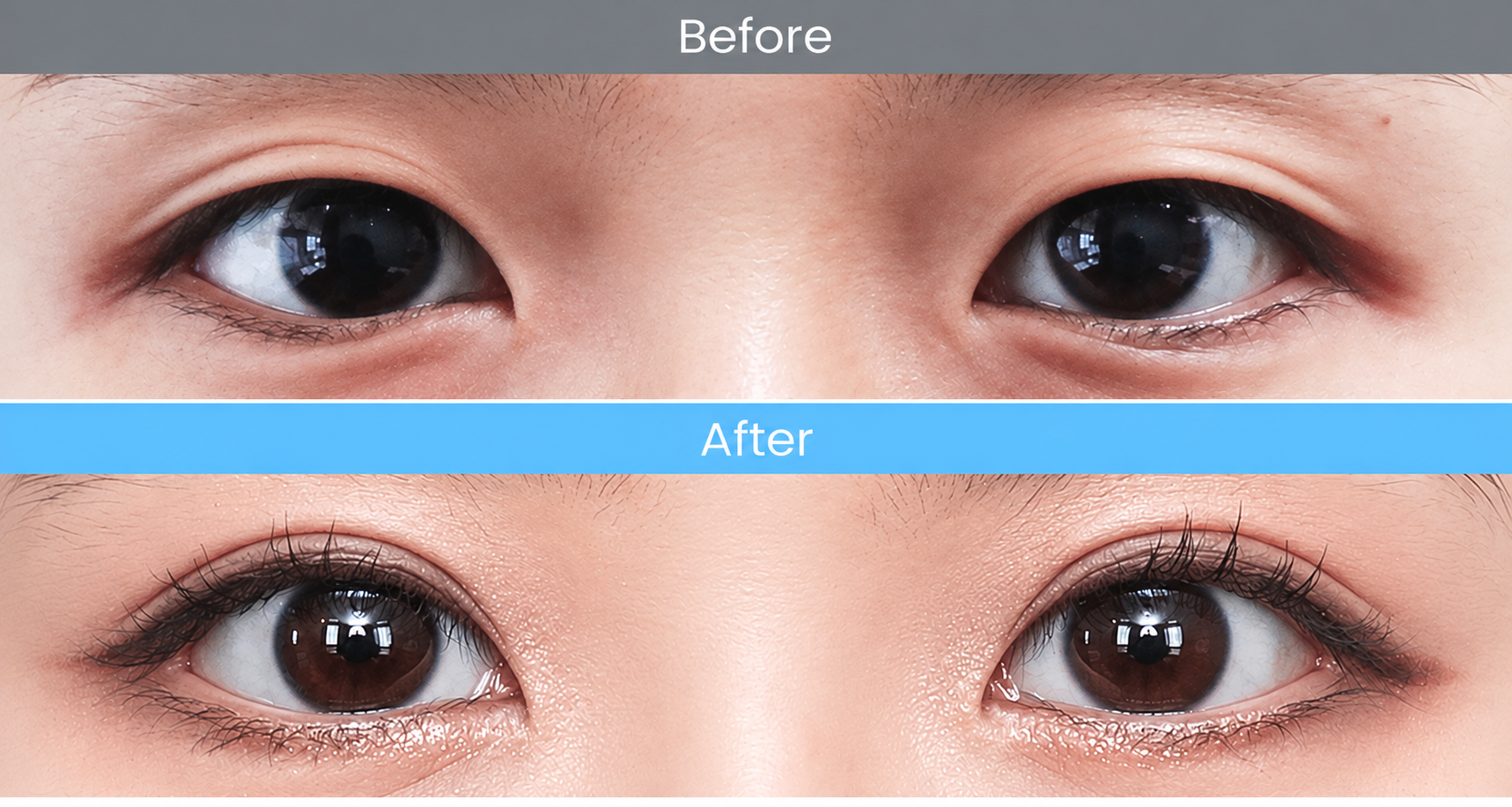
Before-and-after photographs are particularly useful when researching Asian blepharoplasty because they allow you to compare how different crease designs interact with different natural eye shapes.
At Haneul Plastic Surgery, you can review double eyelid surgery cases including different line designs and surgical approaches.
When viewing before-and-after cases, don’t look only at how large the eyes appear.
Pay attention to:
- Where the crease begins
- How visible it is at the inner corner
- Crease height
- How the line changes toward the outer eye
- Balance between the two eyes
- How the crease fits the patient’s original eye shape
Before-and-after cases can help you communicate your preferences, but individual anatomy and results vary.
Traveling to Busan for Asian Blepharoplasty
If you’re traveling from Taiwan, China, Southeast Asia, or another country for Asian Blepharoplasty in Busan, recovery time becomes part of the surgical plan.
You aren’t only thinking about surgery.
You’re also thinking about:
“How will I look before my flight home?”
Swelling and bruising after eyelid surgery vary by individual and by surgical method, so they cannot be completely avoided or predicted.
For international patients, Haneul Plastic Surgery therefore provides a postoperative swelling-care program designed to support recovery before returning home.
Depending on your postoperative condition, this may include a swelling-management package and, when appropriate, additional treatment such as a swelling injection if swelling is pronounced.
Your surgeon and medical team will assess your condition and advise what is appropriate during recovery.
FAQ: Asian Blepharoplasty in Busan
What is Asian blepharoplasty?
Asian blepharoplasty is commonly known as double eyelid surgery. It creates or defines an upper eyelid crease while considering the patient’s existing eyelid anatomy and desired appearance.
What are the four main double eyelid shapes in Korea?
Commonly discussed Korean double eyelid designs include in-line, in-out, semi-out, and out-line. They differ mainly in how the crease begins around the inner eye and how visible it remains across the eyelid.
Which double eyelid shape looks the most natural?
There isn’t one shape that looks most natural on everyone. An in-line generally creates a more subtle crease, while in-out, semi-out, and out-line designs progressively create different levels of visibility. The most natural-looking choice depends on your existing eye structure.
Is an in-out line or semi-out line better?
Neither is universally better. An in-out line generally starts more naturally around the inner corner, while a semi-out line makes the inner portion of the crease somewhat more visible. Your eye anatomy and preferred appearance should guide the choice.
Can I show my surgeon a celebrity photo?
Yes. Reference photos can be useful for explaining your preferred crease height and overall style. However, the exact line should be adapted to your own eyelid anatomy rather than copied directly.
What is the difference between natural adhesion and incisional double eyelid surgery?
Natural adhesion uses fine sutures to create and maintain an eyelid crease through adhesion, while incisional surgery uses an incision and allows more direct correction of eyelid skin and tissues. The appropriate method depends on your eyelid condition and surgical goals.
Can international patients have Asian blepharoplasty in Busan?
Yes. International patients can plan their consultation, surgery, and postoperative care around their travel schedule. Haneul Plastic Surgery provides multilingual support and a postoperative swelling-care program for patients who need to return home after surgery.
Find the Double Eyelid Line That Fits Your Eyes
You don’t need to decide between in-line, in-out, semi-out, or out-line before arriving at the clinic.
Bring the photos you like.
Tell us whether you want something subtle, defined, or somewhere in between.
At Haneul Plastic Surgery in Busan, your surgeon can evaluate your eye structure and help design a double eyelid crease and surgical plan that works with your individual anatomy.